
The product
A full security platform that encrypts secrets and conceals them inside ordinary text or images, with measurable imperceptibility, integrity verification, detection tools, and a complete REST API.
Live product
The Steganography Pro homepage: encrypted concealment for ordinary text and images.
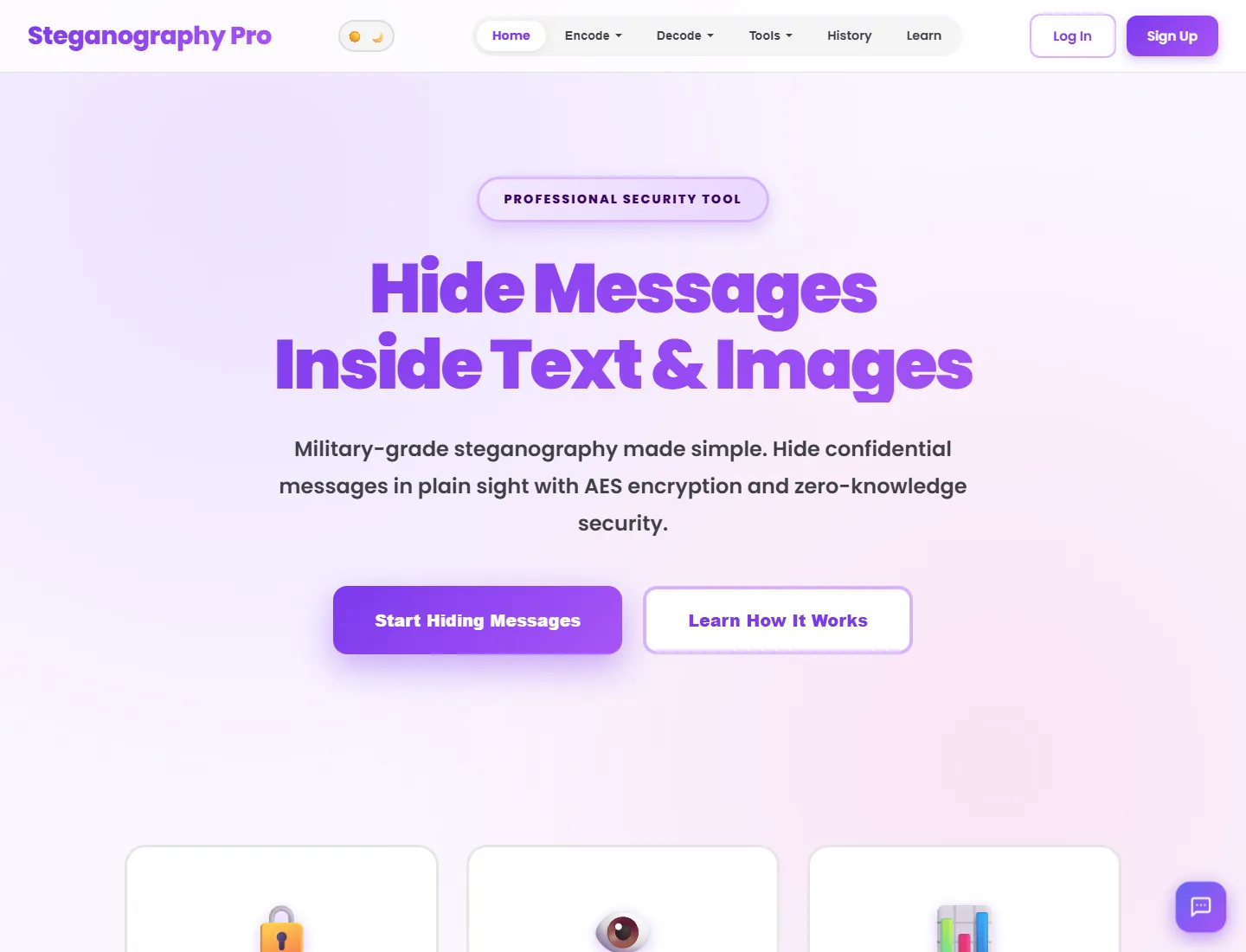
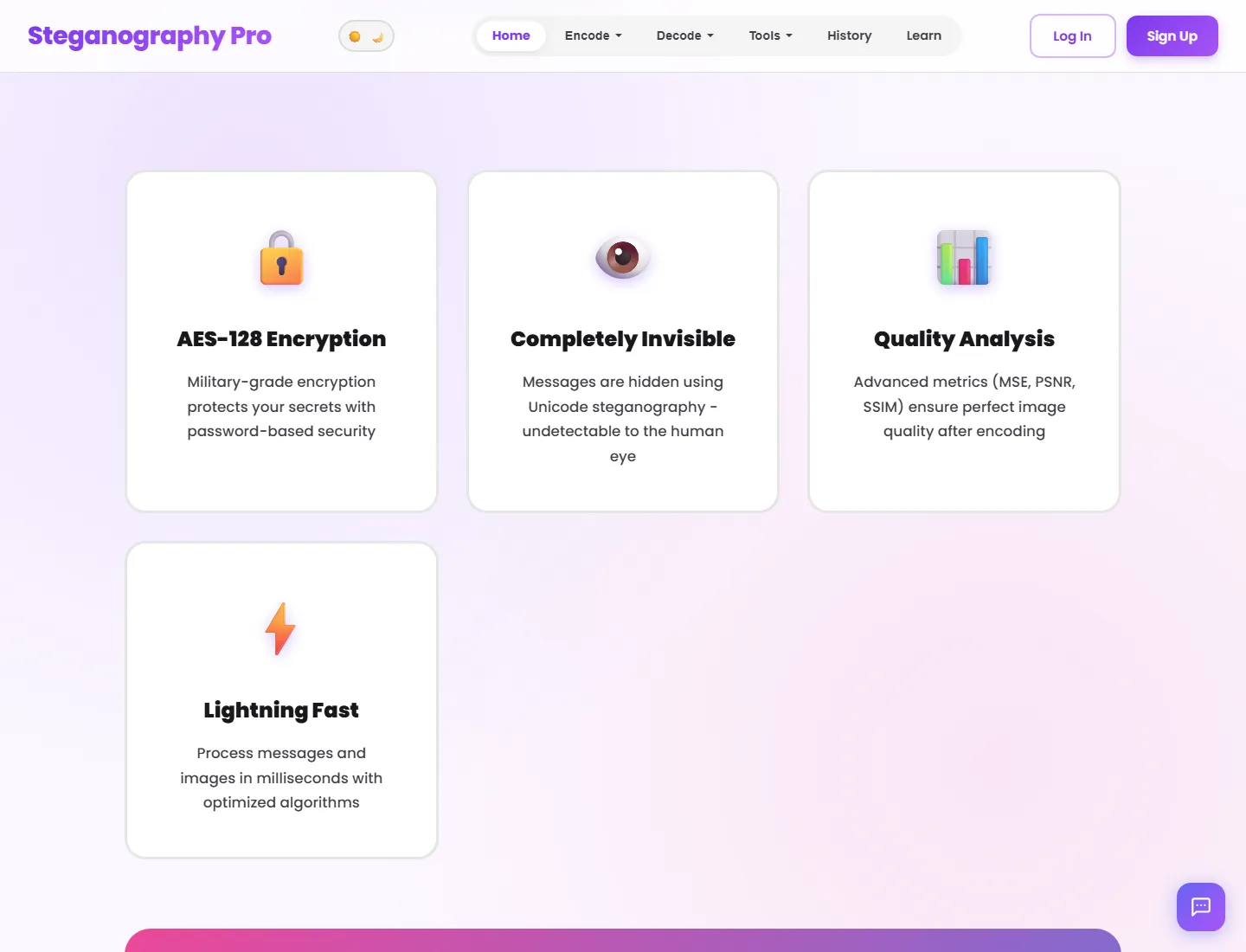
Encrypted concealment for ordinary text and images, exercised end to end in a live product.
Open live productConceal the message, not just its meaning
Steganography Suite protects a secret in two stages. The message is encrypted and authenticated first; the protected payload is then embedded inside an ordinary text or image carrier. Recovery verifies integrity so a modified carrier cannot quietly produce trusted output.
The platform supports two independent concealment systems: zero-width Unicode characters for text and least-significant-bit encoding for images. A shared product layer adds accounts, operation history, capacity guidance, analysis, challenges, a leaderboard, AI-assisted explanations, burn-after-reading messages, and REST access.
The secure path
- Derive key material from the password using 100,000 PBKDF2 iterations.
- Encrypt the message and attach an HMAC integrity check.
- Measure the selected carrier’s available capacity.
- Embed the protected payload with the appropriate text or image strategy.
- Analyze quality, timing, and detection signals.
- Extract, authenticate, decrypt, and, when applicable, reconstruct split payloads.
Capacity errors are surfaced before destructive work begins. Recovery rejects altered data instead of returning a plausible but untrusted message.
Measuring “invisible”
An image that appears unchanged to one person is not enough evidence. The suite records mean squared error, peak signal-to-noise ratio, structural similarity, capacity, encoding and decoding time, and detection confidence.
Standard image configurations achieve 50+ dB PSNR and 0.999+ SSIM. A 512×512 carrier configured at two bits per pixel holds approximately 64 KB. Text workflows complete in a median 340 ms, while image encode/decode completes in a median 1.3 seconds.
A complete platform surface
The implementation spans more than 9,600 lines across product modules, APIs, tests, and documentation, exposes 31 REST endpoints, and reaches 94% automated coverage across core cryptographic workflows.
That breadth matters because the project is not a single encoding function. It connects applied cryptography, concealment, integrity, measurable carrier quality, detection, authentication, history, and developer access into a system that can be evaluated from both a security and a product perspective.